Stay up to date with BK Helmet's latest company news, new product launches, motorcycle helmet industry trends, international safety standard updates, and global exhibition announcements.
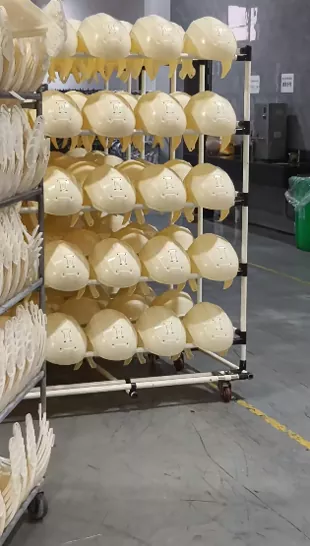
This on-site factory feature reveals the core difference between high-quality certified motorcycle helmets and low-end products by documenting the complete standardized manufacturing process with real workshop footage. The full workflow covers six key stages: high-strength ABS/composite fiber one-piece shell injection molding, precision trimming with triple polishing, electrostatic spraying and custom pattern printing, EPS shock-absorbent liner assembly, rigorous multi-index safety performance testing, and export-grade pressure-resistant packaging. All helmets comply with ECE, DOT and other international safety standards through full-process quality screening. With stable in-house production capacity, we support both small-batch trial orders and large-scale wholesale, as well as full OEM/ODM customization for global distributors, motorcycle retailers and bulk clients.
The ECE 22.06 motorcycle helmet safety standard has been fully implemented in 2026, replacing the former ECE 22.05 version as the latest global safety benchmark. Developed by the UNECE, the updated regulation adds stricter testing for high-speed impact, low-temperature structural tolerance and chin guard integrity, greatly lowering head injury risks in complex crash scenarios. The EU and several Asian markets have ceased production and sale of helmets that fail to meet the new standard, accelerating the clearance of non-compliant low-quality products from the market. Professional safety institutions recommend replacing all motorcycle helmets within 5 years of manufacture regardless of usage frequency, and remind riders to check for the official ECE 22.06 certification label when purchasing to ensure reliable riding protection.
Amid updated safety regulations, evolving helmet technologies and a flood of uncertified low-quality products in the 2026 market, choosing a reliably protective motorcycle helmet has grown increasingly challenging for riders of all levels. This comprehensive buying guide breaks down every critical purchasing factor, including the latest ECE 22.06, DOT FMVSS 218 and Snell 2026 certification standards, style matching for different riding scenarios, performance differences between ABS and carbon fiber materials, scientific fitting methods and common purchasing pitfalls. It helps riders move beyond superficial factors like appearance and price to select a certified, well-fitted, scenario-appropriate helmet that delivers genuine crash protection.
This in-depth production line tour walks through our end-to-end automated ABS helmet manufacturing process, from raw material inspection and precision injection molding to high-density EPS liner fabrication, surface finishing and full-process quality control. All helmets adopt impact-resistant ABS material with a dual-layer safety structure, complying with mainstream international safety certifications. We also offer one-stop OEM customization covering appearance, functional design and full-range motorcycle protective gear, supporting flexible order volumes for global brands, distributors and retailers.
Compliant with GB811-2022 Class A standards, our full-face helmets use ABS shell and EPS buffer to shield the entire head and chin. They feature ventilation, anti-fog lenses and washable liners for safe, comfy all-scenario riding.
Wind noise is the unseen culprit that saps the most energy during long-distance rides. Many cyclists assume that all helmets are equally noisy, but in reality, the level of wind noise control is a key indicator of a helmet's engineering design. This article breaks down the sources of helmet wind noise, the differences in noise levels between various helmet styles, and how to assess a helmet's noise-reduction performance when making a purchase.
We use cookies to offer you a better browsing experience, analyze site traffic and personalize content. By using this site, you agree to our use of cookies. Privacy Policy


 20 2026-07
 20 2026-07
 03 2026-07
 01 2026-07
 12 2026-06