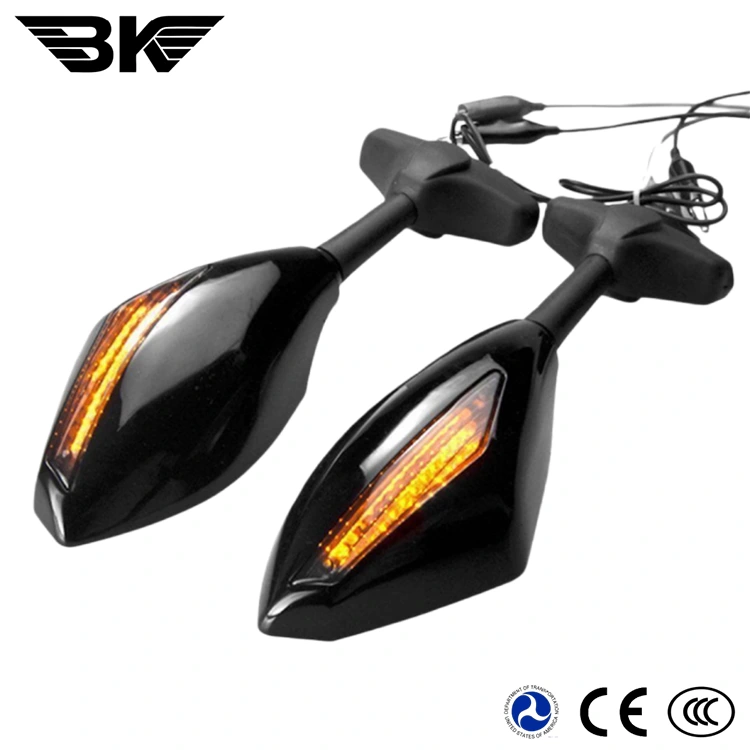
First, stop the vehicle and turn off the power. Then, make sure to sit in the correct posture, with both feet on the ground, both hands on the handlebars, and the body upright. Align the center of the rearview mirror with the height of your eyes, so as to ensure the accuracy of the field of vision.
Next, adjust the angle. Turn it 30-45 degrees to the left and right, and make the upper edge of the mirror level with the horizon. For the left rearview mirror, when adjusting, ensure that "sky and ground" each occupy half, and the vehicle body takes up 1/4. For the right rearview mirror, the ground should occupy 3/4 and the vehicle body 1/4. The central rearview mirror should make "sky and ground" each occupy half.
After the adjustment is completed, conduct a riding inspection. Make minor adjustments based on the actual situation, as different models and personal habits require flexible changes. Specifically, when adjusting the left rearview mirror, keep your body naturally straight and your head upright. Through the adjustment, make sure that the mirror can just show the left rear edge of the vehicle, and ensure that about one-third of the rear view is the vehicle itself and two-thirds is the road condition behind. Such an adjustment allows you to clearly observe the side of the vehicle and the dynamics of the vehicles behind, providing a guarantee for safe riding.
The adjustment of the right rearview mirror is also important. Keep your body upright and your head straight, and appro`priately adjust the rearview mirror outward. Make sure you can see the right rear edge of the vehicle and the road conditions behind the car. This helps you detect approaching vehicles and pedestrians from the right rear in time and avoid potential dangers.
It should be noted that the adjustment methods for different shapes of mirrors, such as circular and square, may vary slightly. Flexibility is required in handling the situation. Everyone has different heights and sitting postures, which will also affect the field of vision of the rearview mirrors. Therefore, after the initial adjustment, a short-distance riding test is indispensable. During the riding process, check if there are any blind spots in the field of vision and make dynamic adjustments according to the actual situation.
Furthermore, during the process of adjusting the rearview mirror, don't forget to check its fixation status. If the rearview mirror becomes loose, it should be tightened promptly to prevent shaking during riding which may affect the field of vision. Also, always keep the mirror surface clean to avoid any obstructions that might block the view.
In conclusion, the optimal adjustment of the rearview mirror on an electric motorcycle is not achieved in a single step. It requires us to carefully consider multiple aspects. From the static adjustments of the sitting posture, height, and angle, to the dynamic fine-tuning during riding tests, and even the daily attention to the fixation and cleaning of the rearview mirror, each step cannot be ignored. Only in this way can a favorable visual environment be created for riding, ensuring the safety of the ride.
We use cookies to offer you a better browsing experience, analyze site traffic and personalize content. By using this site, you agree to our use of cookies.Privacy Policy